
BLOG: Pro bono lawyering can unlock hope in uncertain times
When human rights campaigners in Northern Ireland find their activism overlaps with legal issues, their work doesn’t have to stop.
What links high-profile legal challenges to advance an Irish language strategy, the successful court case resisting fossil fuel infrastructure in Whitehead, and the first NI-specific guide on the legal right to protest?
All of these developments were powered by pro bono legal advice or representation shared by lawyers, completely free of charge.
When human rights campaigners in Northern Ireland find their activism overlaps with legal issues, their work doesn’t have to stop. Instead, they can pivot to incorporate expert support from collaborative lawyers in their ongoing advocacy and campaigning work.
These partnerships are made possible through PILS’ Pro Bono Register initiative.
What is the Pro Bono Register?
The Pro Bono Register is a list of dedicated solicitors, barristers and legal academics who share their knowledge with experts from PILS membership network working on public interest issues. These legal professionals have been a trusted ally in some ground-breaking movements for social change:
Case studies:
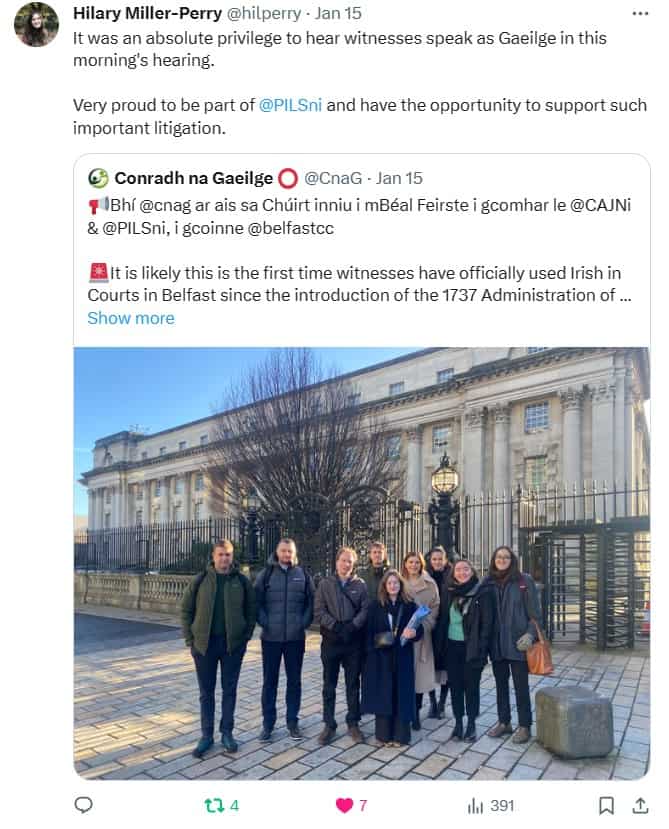
Irish was spoken inside a Belfast court building for the first time in 300 years, as part of a community-centred litigation strategy demanding transparency on public signage decision making.
Faced with the prospect of having a dormant fossil fuel plant expanded on the shores of Belfast Lough, the Stop Whitehead Oil Terminal campaign group successfully challenged the council’s planning decision, represented in court by pro bono lawyers.
When local activists reported harassment as a result of their organising, a group of pro bono lawyers researched the first Right to Protest Guide designed for this jurisdiction, giving confidence to campaigners across the north of Ireland.


To any lawyer reading this who hasn’t engaged in pro bono work yet, consider this:
Pro bono is a gateway to professional development.
In the 15 years since PILS created our Pro Bono Register, we’ve witnessed many practitioners actively expanding the scope of their legal practice.
Whether it’s exploring a new area of law, running your own consultation meetings for the first time, or teaming up with a human rights organisation whose vision aligns with a social issue you care deeply about, pro bono work can give you practical opportunities to develop your skills outside your typical day-to-day practice.
Wesley McGrady BL shared his experience on PILS’ To Be Fair NI podcast (from 10.27)

Pro bono can be a flexible process.
When we connect local human rights defenders and pro bono lawyers, PILS don’t disappear into the background. Every pro bono matter we support is a bespoke partnership between you, the PILS member organisation and the PILS staff team.
You can tell PILS exactly how much time you want to commit, the types of matters you do and don’t have capacity to take on, and if you need a break from the Register during a sabbatical or parental leave.
Pro bono is a source of hope during crisis.
Getting out from behind a screen.
Connecting with humans who are focused on finding solutions to the challenges facing human rights, democracy and the rule of law.
Having honest conversations about how change actually is possible.
All of these exercises are not only part of the pro bono experience, but they are also powerful antidotes to the sense of despondency that can too easily creep over us when we scroll our news feeds for too long.
Pro Bono Register matters are active, future-focused work that combines legal knowledge with human rights expertise. They are bite-sized case studies of hope.
On 10 June 2026, join our European Pro Bono Week Seminar to discover how you can be part of this hopeful and successful legal community.
